A packet of wall plugs says 25 kg. You hang a shelf that will hold maybe six kilos of books. Six months later the shelf is on the floor and there are two ragged craters in the plasterboard.
Nothing about that is mysterious, and the anchor did not lie. It was rated for a different load, in a different direction, in a different wall.
Two forces, two very different numbers
A fixing can be pulled in two ways, and they are not equivalent.
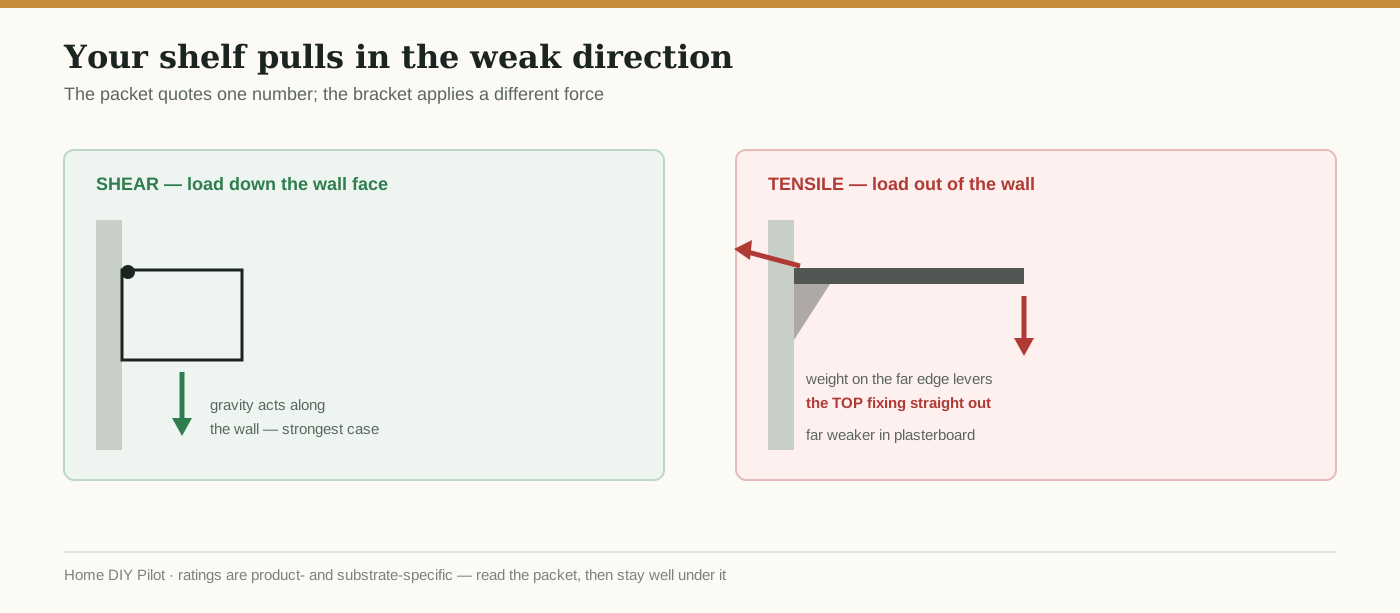
Shear is load acting straight down the face of the wall — a picture hanging on a hook. The fastener is being sheared across its shaft, and this is the direction fixings handle best.
Tensile, or pull-out, is load acting straight out of the wall. This is what a shelf does. The moment the bracket sits proud of the wall, gravity on the far edge levers the top fixings outward. A shelf 25 cm deep multiplies that leverage considerably, and pull-out capacity in plasterboard is dramatically lower than shear.
When a packet quotes a single headline figure, it is usually the flattering one. Your bookshelf is testing the other.
Substrate decides more than the anchor does
The same plug behaves like a different product depending on what it goes into.
Solid brick or concrete is the friendly case: an expansion plug has real material to grip. Plasterboard over a cavity is a thin, weak skin — perhaps 12.5 mm of gypsum — and a plastic expansion plug in it is essentially gripping cardboard. Plasterboard over dot-and-dab, where the board floats on adhesive blobs with a void behind, is worse again, because the plug expands into nothing.
So the first question is never "which anchor" but "what am I actually drilling into." Knock along the wall, check whether there is give, and if you get a hollow sound with a soft, easy drill, treat every rating on every packet as optimistic.
The hierarchy that actually holds
For anything with weight and leverage, in order of preference:
Into the framing. A screw into a stud or timber behind the board beats any anchor. Find studs, mark the centre, and design the bracket spacing around them rather than around where you wanted the shelf.
Toggle or butterfly-type fixings. These pass through the board and open behind it, spreading load across a much larger area of the back face. For real weight in a hollow wall, this is the honest answer.
Metal self-drilling anchors. Better than plastic, still limited, and they chew the board badly if overtightened.
Plastic expansion plugs. Fine for a picture, a smoke alarm, a light curtain rail. Not for shelves, cabinets, TVs, or anything a child might pull.
The habit that prevents most failures
Derate everything, deliberately.
Manufacturer figures are typically laboratory maxima, achieved with the correct drill diameter, a clean hole, the right board thickness and static load. Your wall is thirty years old, the hole is a bit oversized because the bit wandered, and the load is dynamic — books get pulled off, doors get slammed, someone leans on it.
Treat the packet number as a ceiling you should stay well beneath, distribute weight over more fixings than seems necessary, and never let a single anchor carry a load whose failure would hurt someone.
One more thing about failure mode: in plasterboard, anchors rarely fail gracefully. They hold, and hold, and then the board face tears out in one go, taking a fist-sized piece with it. There is no warning sag to react to, which is exactly why the margin has to be built in at installation rather than monitored afterwards.
Spacing and the batten trick
Two fixings carrying a shelf are not twice as strong as one, because the load does not share evenly — the top row takes nearly all the pull-out while the bottom row mostly acts in compression against the wall. Widening the bracket spacing helps more than adding fixings to the same bracket, because it reduces the leverage each one sees.
Where a shelf has to go somewhere with no stud behind it, the reliable move is a timber batten screwed into two studs, with the shelf mounted to the batten. It looks like more work and it converts an unsolvable hollow-wall problem into an ordinary screw-into-wood problem. On a rental wall it also concentrates the damage into a repairable line rather than scattered blowouts.
Where to stop
Anything mounted above a bed, a cot or a sofa; anything heavy on a wall you cannot identify; anything on a wall that sounds hollow where you expected solid; anything where you have already blown out one hole and are tempted to reuse it slightly bigger — those are the moments to fit a timber batten across two studs and mount to that instead, or to hand it to someone who does this daily.
The blown-out hole deserves its own warning. The instinct is to push in a larger plug. What you have actually done is remove the material the next fixing needs, and the second failure is usually worse than the first.