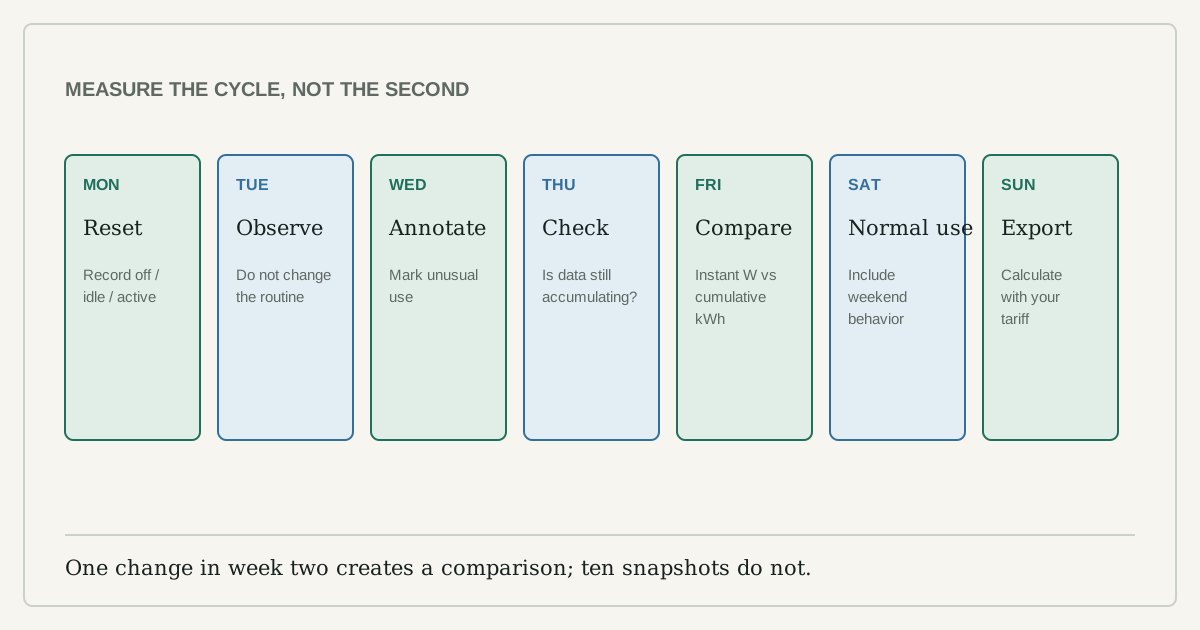
A smart plug with energy monitoring is useful when it answers a small question: what does this one appliance consume in the way it is actually used? It is much less useful when a single watt reading becomes a verdict on an entire room. Compressors cycle, chargers taper, printers wake themselves, and computers move through several power states. A seven-day log captures those changes without pretending to be a laboratory test.
The method below is for ordinary plug-in appliances that remain within the smart plug manufacturer's stated voltage, current, power, and load-type limits. It is not a reason to put a heater, cooking appliance, motor load, medical device, or safety-critical appliance on an unknown relay. Read both labels first. If the load is excluded or close to the rating, do not run the test.
Decide what question the week should answer
Write one question before pairing the plug. Good questions have two choices at the end:
- Does the coffee machine use enough energy while idle that switching it off overnight is worth the inconvenience?
- Is a desk setup drawing power because the computer sleeps, or because monitors and accessories remain active?
- Does the dehumidifier run for a few concentrated hours or cycle throughout the day?
"How much power does my home use?" is too broad for one plug. So is "Which device wastes electricity?" The meter only sees the load connected through it, and its own measurement resolution limits how confidently it can describe very small loads.
Record states, not just numbers
Start with a plain table. The labels matter more than decimal precision.
| Time | Appliance state | Instant power | Energy total | What changed |
|---|---|---|---|---|
| Monday 08:00 | Off but plugged in | reading | baseline | Test begins |
| Monday 10:00 | Active cycle | reading | total | Normal use |
| Monday 18:00 | Idle | reading | total | No user input |
| Tuesday 08:00 | Off but plugged in | reading | total | Overnight interval |
Use the plug's cumulative energy figure, normally shown in kilowatt-hours, as the main record. Instant watts are a useful clue, but a cycling appliance can be caught at its quietest or busiest second. The Department of Energy's standby-power method makes the same distinction: a stable load can be read directly, while a fluctuating load must be observed over a period.
The seven-day run
- Photograph the appliance rating plate and the smart plug rating before connecting anything. Keep private serial numbers out of the frame.
- Reset the plug's energy counter at a known time. Write that time in the table.
- Use the appliance normally. Do not create an artificial "perfect" week by changing every habit during the measurement.
- At the same time each day, record cumulative energy and the current appliance state.
- Note unusual events: guests, a missed workday, a long cooking session, a firmware update, or the appliance being unplugged.
- At the end of day seven, export or photograph the result before resetting the counter.
If the app loses data when the internet drops, that is itself a result. A meter that cannot preserve local totals during a service outage may be poor evidence for future comparisons.
Turn the total into a decision
Take the seven-day kilowatt-hour total and divide by seven for a daily average. Multiply by 365 only when the measured week resembles a normal week. For cost, multiply energy by the all-in electricity rate shown on your own bill. Do not copy a tariff from a search result; Swiss tariffs vary by supplier, municipality, time band, and bill component.
Then compare the possible saving with the cost and friction of automation. Saving a tiny standby load rarely justifies buying several new connected plugs. A schedule may still be worthwhile for convenience, but call it convenience rather than an energy payback.
For a device with several modes, run a second week after changing one thing only: a sleep timer, a shutdown habit, or a schedule. Two comparable weeks are stronger evidence than ten screenshots from one afternoon.
Measurement traps that change the answer
Very low loads can sit near the meter's resolution. Wi-Fi outages can create blank intervals. A plug may report energy correctly but round its instant-power display. Some devices draw a short startup surge that the app graph smooths away. A multi-socket strip hides which item changed unless everything else stays constant.
The plug itself also consumes some power, so do not use it as proof that a fraction-of-a-watt saving is real. The purpose is household diagnosis, not certification testing.
Keep the connected part secure
The energy meter is now another internet-connected device. Change any default password, enable automatic updates where available, and use two-factor authentication for the account if the platform offers it. Record the model and app name so the device can be removed cleanly when support ends. If you stop using it, reset it and delete its account link rather than leaving a forgotten relay on the network.
When the measurement is not safe to continue
Stop immediately if the plug or outlet becomes warm, discoloured, loose, noisy, or smells unusual; if the relay chatters; if the appliance exceeds the label limits; or if the manufacturer excludes that load type. A measurement is never worth improvising around an electrical warning sign. For fixed wiring, damaged outlets, high-current appliances, or uncertain circuits, use a qualified electrician rather than a plug-in experiment.