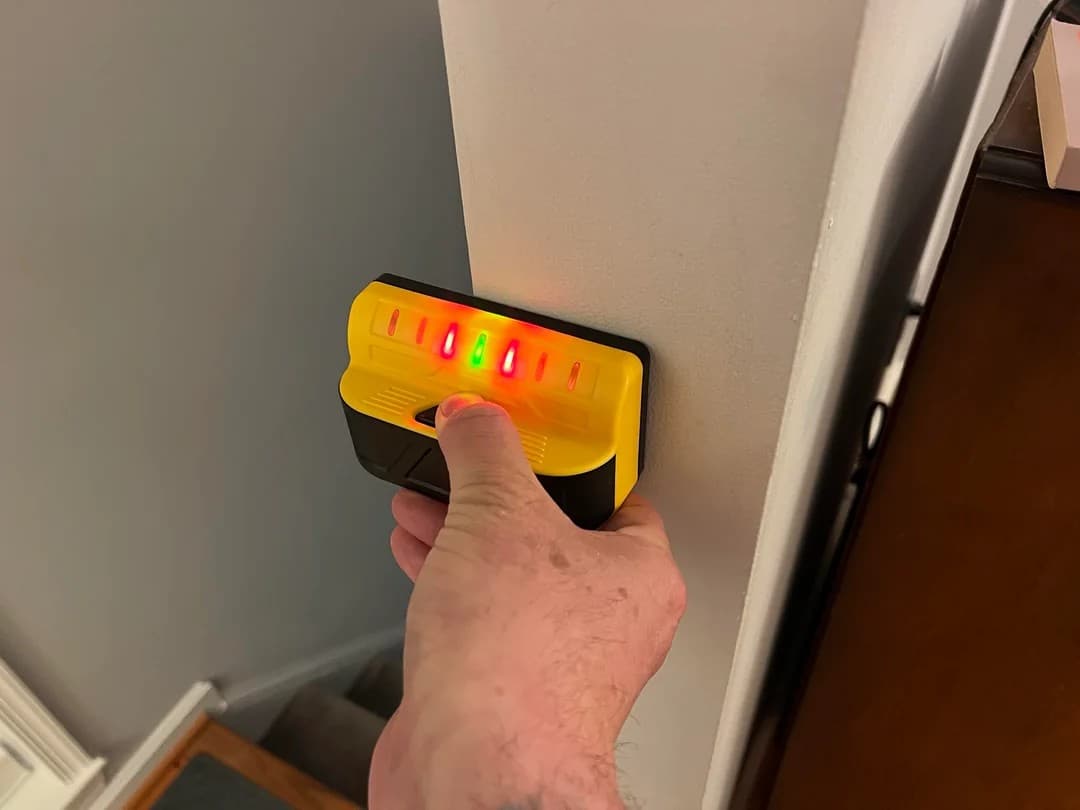
Most drilling accidents are not dramatic; they're a screw through a pipe you find out about when the ceiling below stains, or a bit into a cable you discover when the breaker trips. Five minutes of checking prevents nearly all of them. Work in this order.
What the room already tells you
Wiring usually runs vertically up from outlets and switches and horizontally between them, so treat the columns directly above and below any outlet or switch as suspect. Plumbing tends to live in walls behind and beside kitchens and bathrooms and below upstairs fixtures. If you're about to drill in one of those zones, raise your caution level before any tool comes out.
Finding the studs
An electronic stud finder is the standard tool; calibrate it on a known-empty section of wall and mark both edges of each stud so you know the center. Cross-check the low-tech way: studs are typically spaced a regular distance apart (commonly about 40 cm / 16 in, sometimes 60 cm / 24 in on center), and knocking sounds solid over a stud and hollow between. Hanging anything heavy? You want a stud or a proper cavity anchor, not drywall alone.
Wires and pipes need a separate check
A basic stud finder detects density, not electricity. For wires, use a multi-scanner or a non-contact voltage tester rated for the job; many combo stud finders include a "live AC" mode — sweep the area and watch for the wire warning before you commit. No detector is perfect, so combine it with the from-the-outlet logic in step 1. If a multi-scanner flags metal where you didn't expect it, assume pipe or conduit and move your hole.
How deep are you actually going?
Hanging a light picture into a stud needs very little penetration; you rarely need a long screw or deep hole for a small mount. The deeper you go, the more you're betting on your scan. When you can accomplish the task with a shorter fastener, do.
Interior or exterior changes the odds
An interior partition wall is the lowest-risk place to drill: usually studs, drywall, and the wiring/plumbing logic above. An exterior wall adds insulation, sometimes a vapor barrier, and often more wiring near the top and bottom plates — and on masonry or brick-backed walls you're into anchors and dust, not studs. Bathrooms and kitchen backsplashes are the highest-stakes spots because supply and drain lines hide right where you want to mount things. Knowing which wall you're in tells you how cautious to be.
Own one, borrow the other
For occasional jobs, a decent combo stud-and-AC-wire finder plus a non-contact voltage tester cover most of what a homeowner needs and cost little. You don't need a wall-imaging scanner to hang a shelf — you need to scan carefully, cross-check against the outlets, and respect the stop conditions below. Borrow or rent the heavy gear only for a genuinely uncertain wall.
The point where you stop
Stop and reconsider — or call a pro — if you're drilling in a known wet wall, near the electrical panel, into anything that reads as live, into masonry hiding conduit, or anywhere a mistake reaches gas or a main. Cutting a large opening (not just a pilot hole) raises the stakes further; for anything structural, electrical, or plumbing-adjacent, a tradesperson is cheaper than the repair.
The boring habit that prevents the expensive accident: check the outlet positions, scan twice in two directions, mark your spot, pick the shortest fastener that works, and drill slowly. If the bit suddenly gives or grabs, stop immediately. None of this is about fear; it's about not turning a 20-minute job into a plumber-and-electrician afternoon.
Before the first hole
Stop before drilling if the wall is near a breaker panel, plumbing stack, radiator pipe, bathroom fixture, kitchen sink, thermostat wire, or an unknown old repair. Stop if a stud finder gives inconsistent readings in the same spot, if the wall sounds hollow in an unexpected way, or if the planned screw length is longer than the project needs. A smaller pilot hole is not permission to ignore risk; it is only one check. For renters, also stop when the lease does not allow holes or when the mount would be hard to patch cleanly. The safest DIY instruction sometimes ends with "use a freestanding option instead."
Write the plan on the wall in pencil
Before making a hole, mark the stud or anchor center, the bracket outline, the fastener length, and the nearest outlet or plumbing clue on painter's tape. Hold the assembled bracket against those marks and confirm that every hole still lands where expected. This catches templates placed upside down, shelf rails shifted off a stud, and screws longer than the combined bracket and wall need. Photograph the tape before drilling so the reasoning is preserved if the first reading proves wrong. If the marks conflict, erase the plan rather than drilling an exploratory hole.