A hole in a wall is a small loan. You take it out in five minutes with a drill and you repay it, with interest, on the day you move or repaint.
That is not an argument against drilling. It is an argument for knowing what you are borrowing.
Start with the question nobody asks
Does this need to be on the wall at all?
A camera on a bookshelf sees the same room as a camera on a bracket. A sensor taped inside a cupboard frame works as well as one stuck to the architrave. A rolling cart holds what a floating shelf holds, and it moves when the furniture moves.
Wall mounting genuinely wins in three cases: the device needs a fixed angle it will not hold otherwise, a shelf needs a load path that furniture cannot give it, or a sensor needs contact with a specific moving part like a door or a window. Outside those, mounting is usually about neatness — which is a real motive, just a much weaker one than the drill implies.
Wanting the room to look tidy is not the same as needing a hole in it.
The load nobody plans for
Shelves are the category that goes wrong most, and it is never the installation that fails. It is the drift.
A shelf goes up to hold keys and a plant. Within a year it holds books, a speaker, a stack of plates, and something heavy that had nowhere else to go. Anchors are chosen for the first version and loaded by the last one.
So size the anchor for the shelf's eventual worst day, not for what you are putting on it this afternoon. And read the rating honestly: anchor packaging generally quotes a static figure in ideal half-inch drywall, and does not describe a shelf being leaned on, tugged, or loaded unevenly at one end.
Where a fixing into a stud is possible, take it. In typical North American light-frame construction studs sit at sixteen-inch centres, sometimes twenty-four, and there is one useful giveaway: electrical boxes are almost always nailed to the side of a stud, so a receptacle or a switch tells you a stud is immediately beside it. That single trick is faster than most stud finders and free. The rest of the method — and the hazards it does not cover — is in the pre-drilling wall check.
Sensors are an adhesive problem, not a mounting problem
Door, window, temperature and motion sensors weigh almost nothing, so the fixing is never the risk. Two other things are.
The first is placement, and it is solved with a day of painter's tape. Mark the outline where the device will go, leave it, and live around it. Open the door it is next to. Sit where people sit. Walk the route at night. Most placement mistakes announce themselves within a few hours and cost nothing at that stage.
The second is the battery. Check before you commit that the sensor can be opened for a battery change without pulling the mount off the wall — because if it cannot, you will be re-sticking it to the same patch of paint twice a year, and paint tolerates that about twice.
Cameras: point it before you fix it
An indoor camera needs a conversation before it needs a bracket, and the question is not technical. Write down exactly what it can see. Then check whether that includes a neighbour's window, a shared corridor, a guest bed, or someone's work screen.
A bracket makes a temporary decision permanent, which is the whole point and also the whole risk. Sort out the field of view, who has account access, and where recordings go, while the camera is still standing on a shelf and can be turned around with one hand.
Why the patch shows
Here is the mechanism, because knowing it fixes the problem for good.
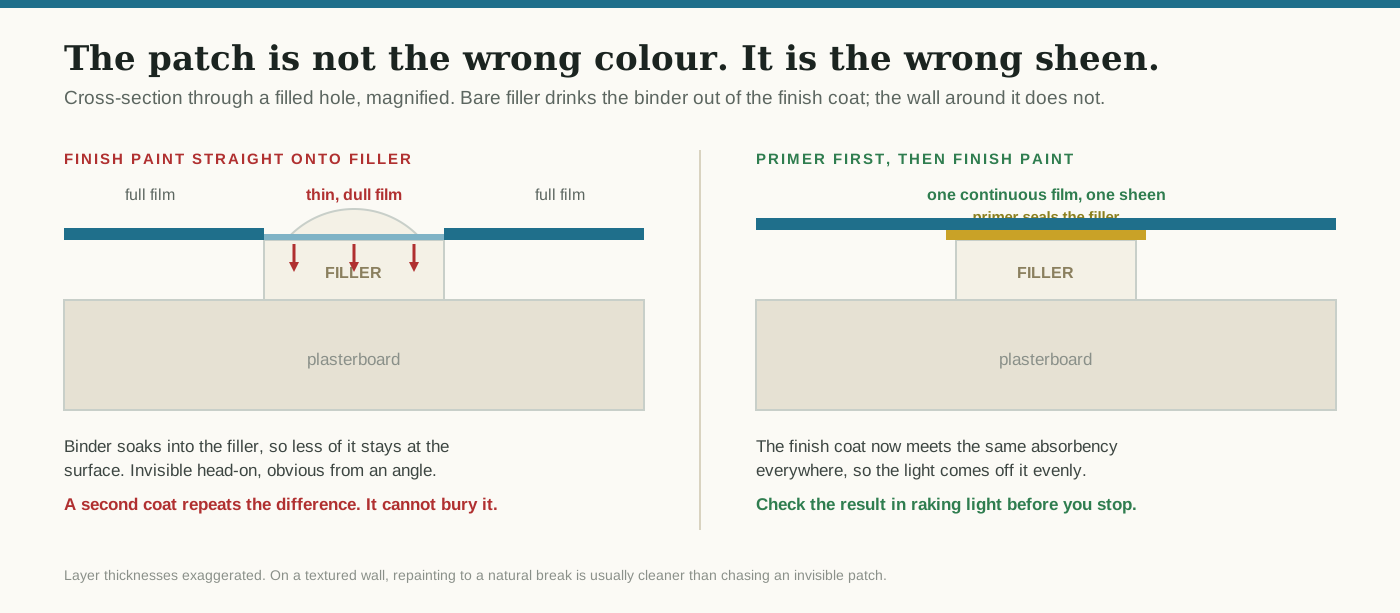
Filler is far more porous than the painted wall around it. When you roll finish paint straight over a bare patch, the filler drinks it and the surrounding paint does not, so the patch dries with a different sheen. It is not a colour mismatch and no amount of extra topcoat will bury it — a second coat differs in exactly the same way. The patch is showing because of how light comes off it, which is why it is invisible head-on and obvious from an angle.
Primer is what stops it. It seals the filler so the finish coat sits on a surface with the same absorbency as the rest of the wall.
So: fill thin and slightly proud, let it dry properly rather than nearly, sand flush with a fine sponge, prime the patch, then paint — and check the result in raking light from a window or a torch held flat against the wall before deciding you are finished. That is the same physics that makes touched-up trim go shiny, where the sheen difference is even less forgiving.
On a textured wall, accept early that a perfect invisible patch is unlikely and that repainting to a natural break — a corner, an edge, the full wall — is the cleaner outcome.
When to put the drill down
Soft, crumbling, or damp material under the surface. A wall that gives when you press it. Staining that has come back after being painted over. A musty smell in the same corner.
That is not a mounting problem, and covering it is the worst available move — the EPA's guidance on painting or caulking a moldy surface is that the paint is likely to peel, which is the wall telling you the problem is still underneath. Find the water first.
Every mount should survive one sentence said out loud: this is the surface, this is the load it will end up carrying, this is how it comes off, and this is how the hole gets repaired. If you cannot finish that sentence, you are not ready to make the hole — you are ready to make the loan.